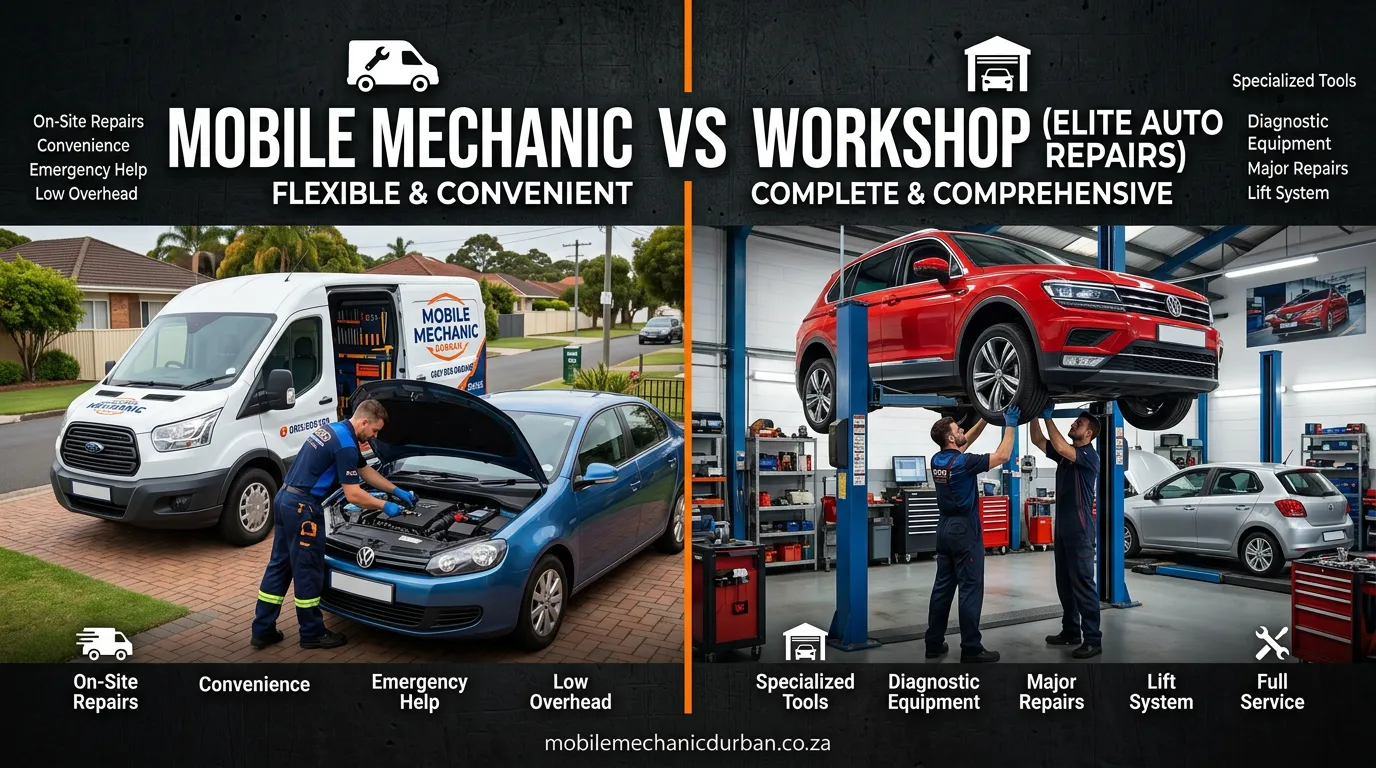
Mobile Mechanic vs Workshop: Which Saves You More in Durban?
If you are comparing a mobile mechanic to a traditional workshop in Durban, the short answer is: for most routine services and common repairs, a mobile mechanic saves you money, time, and hassle. But there are situations where a workshop is the better choice. Here is an honest comparison to help you decide.
Mobile Mechanic vs Workshop: The Comparison
| Factor | Mobile Mechanic | Workshop |
|---|---|---|
| Convenience | We come to you — home, office, or roadside | You drive to them, drop off, arrange transport home |
| Cost | 15–30% lower than dealerships, no overhead markup | Higher overheads passed on to you (rent, reception, waiting room) |
| Time | Zero travel time. Car serviced while you work or relax | Drop-off, wait or arrange a lift, collect later |
| Quality | Same OEM/quality parts, qualified technicians | Same OEM/quality parts, qualified technicians |
| Specialist Equipment | Portable diagnostics, standard tools — covers 90% of jobs | Full hoist, alignment rack, spray booth |
| Transparency | You watch the work happen. No mystery charges | Car disappears into the workshop, you see the invoice later |
Real Scenarios From Durban Drivers
Scenario 1: Office Worker in Umhlanga
Thandi works in Umhlanga and her VW Polo is due for a minor service. If she drives to a workshop in Springfield, she loses at least 2 hours of her workday — drop-off, arrange an Uber back, then reverse the trip later. With a mobile mechanic, we arrive at her office car park at 8am, service the car while she works, and she drives home at 5pm. Total disruption: zero.
Workshop cost: R1,800 service + R200 Uber trips + 2 hours lost productivity
Mobile mechanic cost: R1,500 — done in the car park, no extras
Scenario 2: Mom in Westville
Nokuthula has two kids and her Toyota Fortuner needs new brake pads. Taking a car to a workshop in Westville means loading the kids into someone else's car, waiting around, and hoping the job finishes before school pickup. We come to her driveway, replace the brake pads in about 90 minutes, and she never leaves her house.
Workshop cost: R2,200 + time organising childcare
Mobile mechanic cost: R1,900 — at her driveway, kids stay at home
Scenario 3: Bakkie Owner in Pinetown
Sipho owns a Hilux he uses for his plumbing business in Pinetown. Every day his bakkie is off the road is a day he does not earn. A workshop might keep it for a full day — or longer if parts need to be ordered. We come to his premises first thing, carry common parts on our service vehicle, and get him back on the road the same morning.
Workshop cost: R3,200 + R1,500 in lost income for the day
Mobile mechanic cost: R2,800 — done before lunch, no income lost
Hidden Workshop Costs Most People Forget
The invoice from a workshop only tells half the story. Here is what it typically does not include:
- Towing: If your car will not start or is unsafe to drive, you need a tow truck. Depending on the distance — say from the M4 coastal road to a workshop inland — this can be R800 to R2,000.
- Rental car: If the repair takes more than a day, some drivers hire a car. Even a basic rental is R400–R600 per day.
- Transport to and from the workshop: Uber, taxi fare, or the favour from a friend who has to rearrange their schedule.
- Time off work: Even half a day away from the office has a cost, whether you calculate it or not.
- Unnecessary upsells: When your car is on the hoist and you are not there, it is easy to get a call saying "we also found this and that." With a mobile mechanic, you see everything we do.
When You DO Need a Workshop
We are honest about this — there are jobs that need workshop equipment:
- Wheel alignment: Requires a dedicated alignment machine bolted to the floor.
- Spray painting and bodywork: Needs a spray booth and panel beating equipment.
- Engine rebuilds: Major engine machining needs a proper workshop with a hoist.
- Aircon re-gassing: Requires specialist refrigerant recovery equipment in some cases.
For everything else — car servicing, brakes, batteries, starters, alternators, clutch and gearbox repairs, diagnostics, suspension — a mobile mechanic handles it just as well, often faster, and for less money.
The Bottom Line
For roughly 90% of the services and repairs Durban drivers need, a mobile mechanic is the smarter, cheaper, and more convenient choice. You save on the service itself, you save on hidden costs, and you get your time back. For the remaining 10% of jobs that need specialist equipment, we will tell you upfront and point you in the right direction.
Need a mobile mechanic in Durban? Get a free quote →