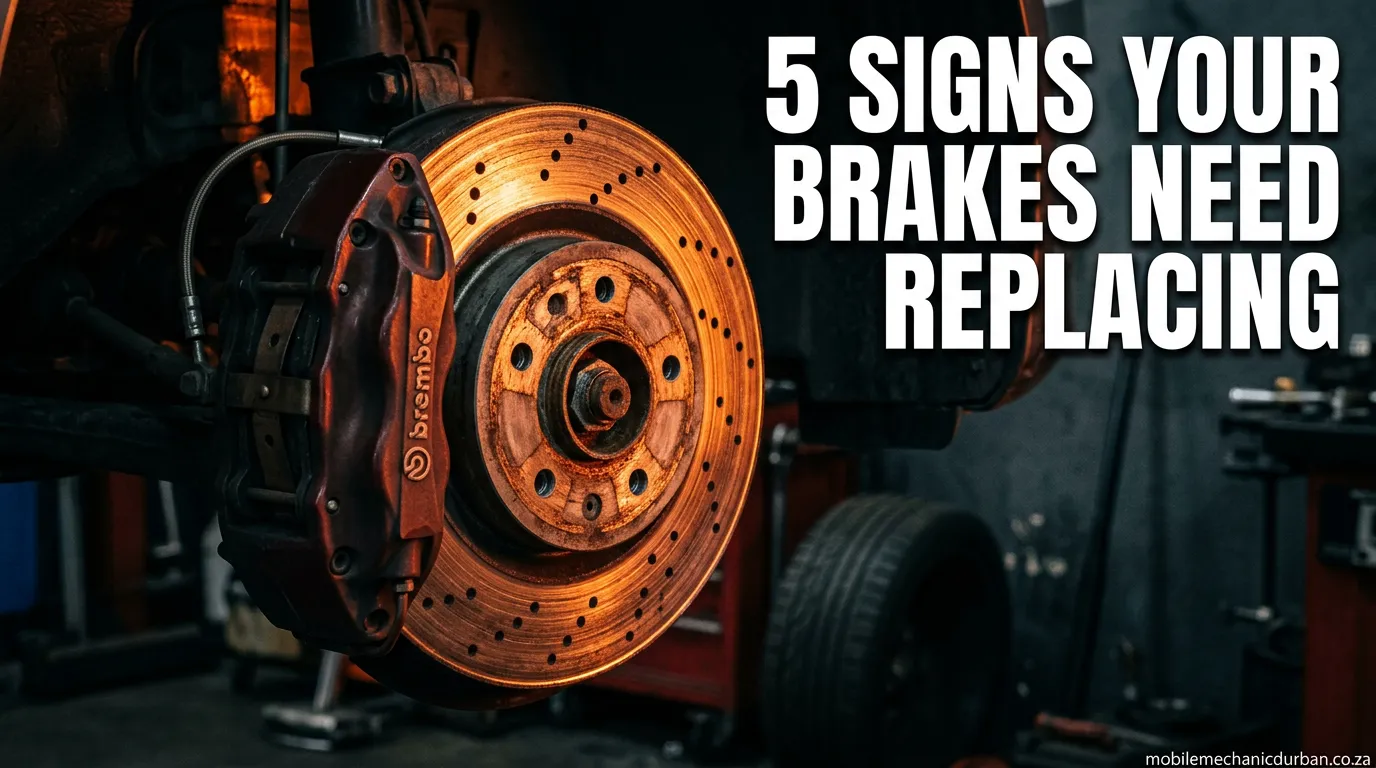
5 Signs Your Brakes Need Replacing — A Durban Driver's Guide
If your brakes are making noise, your pedal feels soft, or your car pulls to one side when stopping, do not ignore it. According to Arrive Alive, brake failure is a leading cause of mechanical-failure crashes in South Africa. Brakes are the single most important safety system on your vehicle, and in a hilly city like Durban — with steep descents along the M13 towards Pinetown and the winding roads through Hillcrest — worn brakes are genuinely dangerous. Here are five clear signs it is time for a brake inspection or replacement.
1. Squealing or Grinding Noise
A high-pitched squeal when you press the brake pedal is your brake pads' built-in wear indicator doing its job. It is a small metal tab that contacts the disc when the pad material is nearly gone. If you ignore the squeal and it turns into a harsh grinding sound, that means metal is grinding on metal — the pad is completely worn through and you are now damaging the brake disc. Disc replacement is significantly more expensive than pads alone, so do not let it get to this point.
2. Car Pulls to One Side When Braking
If your car veers left or right when you brake, one side is gripping harder than the other. This can be caused by uneven pad wear, a seized calliper, or a collapsed brake hose. It is a safety concern because your stopping distance increases and your control decreases — especially in wet conditions, which Durban has plenty of during summer storms.
3. Vibration or Pulsing Through the Pedal
A vibrating brake pedal usually means your brake discs are warped. This happens when discs get excessively hot — common if you are riding the brakes down long hills like the N3 towards Pietermaritzburg or crawling through stop-start traffic on Chris Hani Road. The uneven surface of the disc causes pulsing every time the pad grabs it. Warped discs can sometimes be skimmed (machined smooth), but often they need replacing.
4. Soft or Spongy Brake Pedal
If you press the brake pedal and it sinks further than usual, or feels spongy and lacks resistance, this typically points to air in the brake lines or a brake fluid leak. Both are serious. Air in the hydraulic system reduces braking force. A leak means you could lose braking ability entirely. If your pedal goes to the floor, stop driving and call us immediately — we will come to you with our mobile brake repair service.
5. Brake Warning Light on the Dashboard
Modern vehicles have brake wear sensors that trigger a dashboard warning light when pads reach minimum thickness. If this light comes on, do not assume it is a false alarm. Some vehicles also illuminate the ABS light when there is a sensor fault related to the braking system. Either way, it warrants a professional diagnostic scan sooner rather than later.
Why Durban Conditions Wear Brakes Faster
Durban drivers typically replace brake pads more often than the national average, and there are real reasons for this:
- Hilly terrain: The greater Durban area is built on hills. Driving from Westville down to the coast or navigating the steep roads around Kloof puts constant demand on your brakes.
- Humidity and salt air: Durban's coastal humidity accelerates corrosion on brake discs and callipers. If your car sits for a few days, you might notice a thin layer of rust on the discs — normal for the coast, but it contributes to faster wear.
- Stop-start traffic: The M19, the N2 through Durban, and the M4 coastal route are notorious for heavy traffic, meaning constant braking.
Average Brake Pad Life in KZN
DEKRA recommends brake inspections every 15,000 km to catch wear early. In typical Durban driving conditions, front brake pads last between 30,000 and 50,000 km, depending on driving style and vehicle weight. Rear pads last longer — usually 50,000 to 80,000 km — because the front brakes do most of the work. Heavier vehicles like bakkies and SUVs sit at the lower end of those ranges.
Cost of Brake Pad Replacement in Durban
| Job | Price Range |
|---|---|
| Front brake pads (pair) | R800 – R2,000 |
| Rear brake pads (pair) | R700 – R1,800 |
| Brake discs (pair, front) | R1,200 – R3,500 |
| Full front brake job (pads + discs) | R2,000 – R5,000 |
| Brake fluid flush | R400 – R800 |
Prices vary by vehicle make. A VW Polo front brake pad replacement sits at the lower end; a BMW X3 sits at the higher end. We always quote you an exact price before starting.
Do Not Wait Until It Gets Worse
Worn brakes never fix themselves. The longer you leave it, the more damage is done — and the more expensive the repair becomes. Catching worn pads early means a straightforward R1,000 job. Waiting until the discs are scored means a R4,000 bill. We replace brake pads and discs on-site at your home, office, or wherever your car is parked across the Durban area.
Need a mobile mechanic in Durban? Get a free quote →